

Exhibition by Marisa Cornejo, "El Taller de la Fragilidad"
 Genève, 1204 Genf, Switzerland
- Geneva, Switzerland

 0
0 0
0 0
0
Description
What does it mean to return to a country that has continued to exist without you? This question has permeated the work of visual artist and author Marisa Cornejo for several decades. Born in Chile during the Popular Unity (Unidad Popular, from September 4, 1970, to September 11, 1973), forced into exile with her family under the military dictatorship, the artist does not seek to reclaim a lost territory. Instead, her work interrogates the forms of a belonging that has become discontinuous, where memory is constructed from fragments (real or imagined) that have long been inaccessible. In Reflections on Exile (1984), Edward Said, who dedicated his life to contemplating the political and existential effects of exile, describes the ability of exiled individuals to perceive the world through a "counterpoint" consciousness, where multiple temporalities and geographies coexist without ever merging into a single narrative. The photographs of Marisa Cornejo seem to inhabit this space. By reoccupying, as an adult, places in Chile that she was deprived of as a child, the artist does not stage a return; rather, she documents the gap that separates memory from the present, the image from lived experience. This tension finds particular materiality in Los Tótems de mi Ausencia (The Totems of My Absence), a dozen plaster forms that punctuate the floor of Halle Nord. Partially covered with postcards from Chile, these sculptures give body to a memory long reduced to the surface of images. Created from photographs taken by the artist during recent trips to Chile, these images reactivate emblematic sites whose landscapes have been shaped as much by identity narratives as by tourist imagination. They also draw inspiration from the postcards that her grandparents sent to the artist during her childhood in exile, frozen witnesses of a country she could not access. The artist describes these steles as attempts to "heal the flattening that modern chronology has imposed on our history" by giving volume to memories, so that they occupy space. The exhibition also resonates with the analyses of Nelly Richard. In Crítica de la Memoria (1990–2010), 2010, the Franco-Chilean theorist shows that while the democratic transition did not erase the fractures produced by the Chilean dictatorship, it often covered them with a consensual narrative. In the face of this softening of memory transmission, art has the capacity to make perceptible the continuities between past and present, much like the literary and visual work of Marisa Cornejo. Indeed, whether in her writings, drawings, or sculptures, the artist allows it to surface, sometimes in relief, how it continues to shape landscapes, objects, and bodies. Partly focused on the theme of the mother, a selection of the artist's drawings and dream paintings is also presented at Halle Nord. Since 1997 — the year corresponding to Marisa Cornejo's last exhibition within the collective La Panadería in Mexico City — the artist has been recording her dream visions daily in the form of drawings. These shift this archaeology of memory towards the body. In La Madre que me Enseña a Respirar (The Mother Who Teaches Me to Breathe), memory is no longer organized according to a chronology of events, but according to a logic of sensation and breath. Breathing becomes a genuine critical operation aimed at undoing the flattening produced by trauma in order to restore to the body its capacity to inhabit space. Dreams thus elaborate a non-linear temporality, where individual memory and collective legacies coexist without hierarchy. Ultimately, the drawings of Marisa Cornejo, like all the works presented in El Taller de la Fragilidad, seem to offer a very intimate translation of exilic consciousness: a space where heterogeneous realities no longer seek to resolve but to breathe together.
Highlights
- First institutional solo exhibition in Geneva
- Explores themes of exile and displacement
- Features sculptures and photographs by Marisa Cornejo
General Information
Marisa Cornejo's exhibition, "El Taller de la Fragilidad," showcases her reflections on memory and belonging shaped by her experiences of exile. The event is hosted at Halle Nord in Geneva, presenting a series of works that engage with the complexities of returning to a homeland.
Location
Genève, 1204 Genf, Switzerland
Loading map...
How to get there

Event Calendar
October 2026

Event Media


More events in Geneva

 Ticket: CHF 0
Silvia Sleigh
 12:00 am
- Jun 4 - Oct 25, 2026
- Place de Neuve 1, 1204 Genève, Schweiz
 Ticket: CHF 0
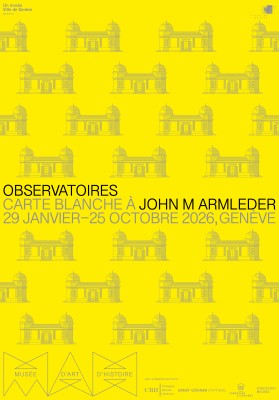
Observatories
- 12:00 am
- Jan 29 - Oct 25, 2026
- Rue Charles-Galland 2, 1206 Genève, Schweiz
 Ticket: CHF 0
Join in! From a Grain of Sand to a Sustainable City
- 7:30 am
- Sep 25 - Dec 18, 2026
- Boulevard Carl-Vogt 66, 1205 Genf, Switzerland

Ready to Host an Event?
Create, manage, and promote your event in minutes.