

A Long-Distance Call. Scenes from the Weimar Republic
 Luisenstraße 33, 80333 München, Germany
- Munich, Germany

 0
0 0
0 0
0
Description
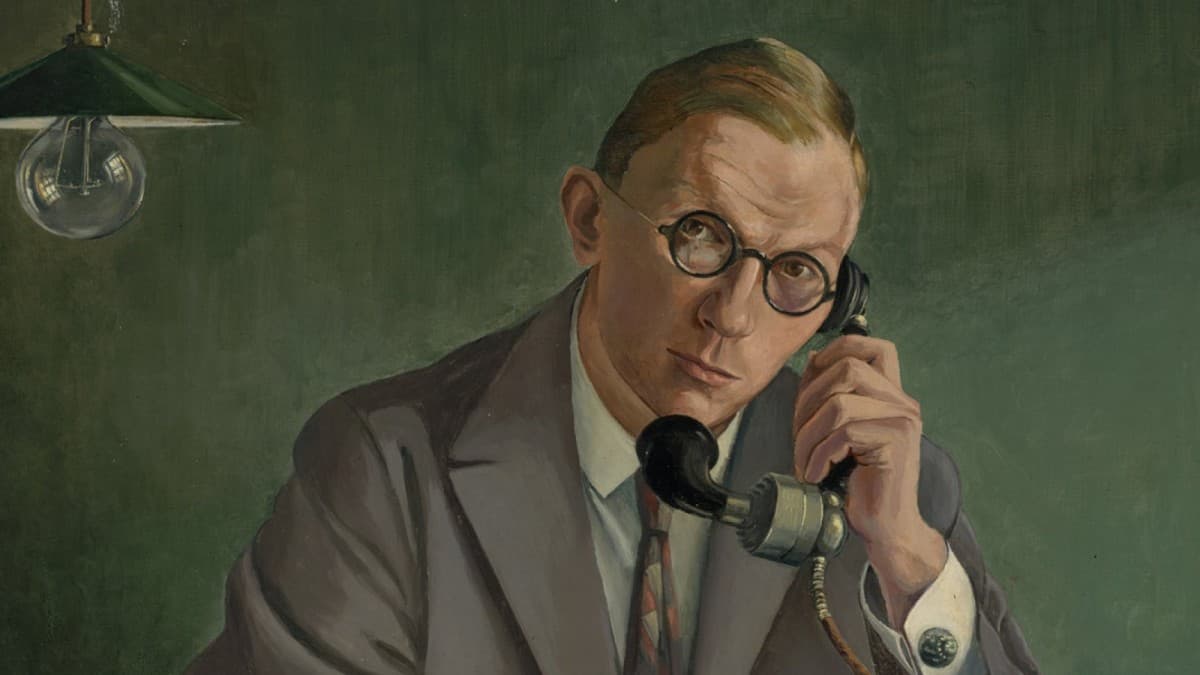
The artist Käte Hoch shows her friend Erich Müller-Kamp talking on the phone at the desk. A long-distance call, as Kurt Tucholsky advises, should be conducted as clearly and dialect-free as possible, otherwise the surveillance officers cannot follow the dialogue. Hoch paints herself in the colors of the suffragettes and with a bob cut. Young employees also cut their hair short. They type quickly, chain-smoke, and go to the cinema or dance hall in the evening. They love Charleston and Shimmy, listen to schmaltzy tunes, swing, and jazz. Irmgard Keun's "Kunstseidenes Mädchen" dreams of slender silhouettes and shoes with lizard caps. Ré Soupault develops a transformation dress that can be converted directly for the evening in the office. In variety shows, gender roles become permeable, monocles send signals. Brothels form an established framework for sex work. The economy flourishes, often on credit, parts of the population impoverish, not only during hyperinflation and the global economic crisis. War veterans, female workers, the unemployed, and violet sellers shape the streets and counteract the Golden Twenties. Oskar Maria Graf distributes anti-fascist leaflets with a working group, feminists and the Munich Anti-War Committee meet in Schwabing, and a local group of the revolutionary artists' association ASSO works on a magazine. George Grosz depicts the rise of the Nazis and caricatures the Hitler salute. Helene Weigel and Bertolt Brecht's new theater longs for the power of boxing and tries dialogues that land like uppercuts. In 1923, the first state-controlled radio broadcast was transmitted in Germany – Max Radler paints a factory worker listening to the radio. In 1930, Tim Gidal takes a photo at the German Museum of one of the first television transmissions. The exhibition focuses on concrete stories and tangible details, rather than making grand theses about the Weimar era. It aims to establish a contact with the lost possibilities of the Weimar Republic – a long-distance call. Featuring works by Käte Hoch, Heinrich Hoerle, Karl Hubbuch, Lotte Jacobi, Grethe Jürgens, Jeanne Mammen, Gabriele Münter, Christian Schad, August Sander, Rudolf Schlichter, and others. In cooperation with the Munich City Museum and with generous support from a private collection. Curated by Karin Althaus, Adrian Djukić, and Matthias Mühling.
Highlights
- Works by prominent artists of the Weimar Republic
- Thematic focus on gender roles and social critique
- Exhibition at Lenbachhaus, Munich
General Information
The exhibition "A Long-Distance Call" showcases works by artists such as Käte Hoch and Christian Schad and illuminates life in the Weimar Republic. It addresses the societal changes and challenges of that time, including the role of women and political currents.
Location
Luisenstraße 33, 80333 München, Germany
Loading map...
How to get there

Event Calendar
May 2026

Event Media

More events in Munich
 Ticket: N/A
Tomás Saraceno. Interwoven Worlds
 12:00 am
- Jul 17, 2026 - Feb 7, 2027
- Prinzregentenstraße 1, 80538 München, Germany
 Ticket: N/A
Steina: Playback
- 12:00 am
- Jun 12 - Dec 7, 2026
- Prinzregentenstraße 1, 80538 München, Germany
 Ticket: N/A
Maria VMier. I follow the wind through the stone
- 12:00 am
- Jun 26, 2026 - Feb 7, 2027
- Prinzregentenstraße 1, 80538 München, Germany


Ready to Host an Event?
Create, manage, and promote your event in minutes.