

Fabian. Der Gang vor die Hunde - Theatertag
 Schönhauser Allee 36-39, 10435 Berlin, Germany
- Berlin, Germany

 0
0 0
0 0
0
Description
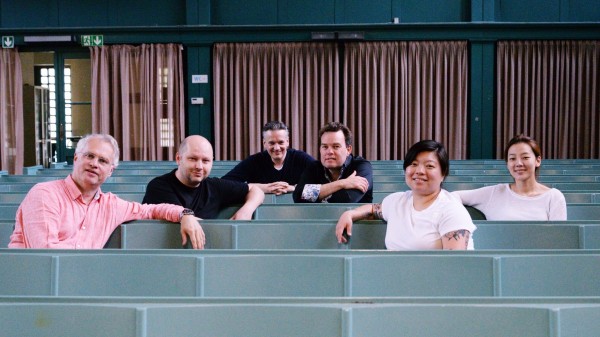
“I sat in a large waiting room, and it was called Europe. Eight days later the train leaves. I knew that. But where it was going and what would become of me, no one knew. And now we are sitting in the waiting room again, and again it is called Europe! And again we do not know what will happen. We live provisionally!” When the unemployed advertiser Fabian wakes up after the last and before the next drunken night at the popular fries stand in the metropolis, he finds himself in tremendous conditions. With the last war behind him and the next in his mind, the population devotes itself to hedonism. “Wonderful,” thinks Fabian and falls back asleep peacefully. Shortly thereafter, a small group gathers around the motionless young man. Two disheveled operators of a popular fries stand in the metropolis, a connoisseur of international film law, an aspiring Germanist in leather pants, the male brothel operator Mrs. Moll, and a communist drag queen ask him: “Young man, what now?” He awakens and replies: “Should I go or not? What should I move forward for? For what and against what? Why am I not at home with my mother, where one can wait for the downfall of Europe just as well? What is the bullet in my left buttock doing? Who makes tea for my mother? When do we arrive and in what company? Is there peace when the wars are over?” Together, they decide to move on to further investigations in the cousin. Erich Kästner's urban novel from 1933 paints a prescient portrait of a society in upheaval. With sharp wit, grotesque exaggeration, and deep melancholy, Kästner depicts Berlin during the late Weimar Republic, a world full of political radicalization and moral decay, where no one is willing to stoop to listen to another. At the center is Kästner's young Fabian as an ironic observer, who cannot find action, is swept away in the whirlwinds of the metropolis, and sinks into loneliness. The ghostly parallels of the novel to the present are often read as a prophecy of the return of the same and absolute catastrophe. In RZt, one does not want to rely on the cultural pessimistic design of an inevitable downfall and does not let Fabian stumble through the metropolis alone. A group of outsiders discusses the fragility of morality, empathy, and resistance amidst today's crisis experiences in the form of their own texts, drag show elements, and the thumping beats of the house band 21 downbeat. Thus, a shimmering cityscape of Berlin emerges, which one can probably only experience in this form at RZt. Funded by the Fonds Darstellende Künste from the resources of the Federal Government Commissioner for Culture and Media and from the resources of the Senate Department for Culture and Social Cohesion.
Highlights
- A theatrical adaptation of Erich Kästner's urban novel
- Explores themes of uncertainty and societal upheaval
- Performed at Theater RambaZamba in Berlin
General Information
Fabian. Der Gang vor die Hunde is a thought-provoking play set in post-war Europe, reflecting on the anxieties of a generation. The performance features a diverse cast and delves into the struggles of its protagonist, Fabian, as he navigates a world filled with chaos and existential questions.
Location
Schönhauser Allee 36-39, 10435 Berlin, Germany
Loading map...
How to get there

Event Calendar
October 2026

Event Media


More events in Berlin
 Ticket: N/A
SPECTRUM CONCERTS BERLIN
 8:00 pm
- Sep 30 - Dec 7, 2026
- Herbert-von-Karajan-Straße 1, Berlin, 10785, Germany
 Ticket: N/A
Saying the Wrong Thing — English Stand-up Comedy in Berlin
- 8:00 pm
- Sep 16, 2026 - Mar 3, 2027
- Grünberger Str. 84, Berlin, 10245, Germany
 Ticket: N/A
JUAN PABLO LÓPEZ: DESDE CHILE A BERLÍN
- 8:00 pm
- Sep 30, 2026
- Marlene-Dietrich-Platz 1, Berlin, 10785, Germany


Ready to Host an Event?
Create, manage, and promote your event in minutes.