

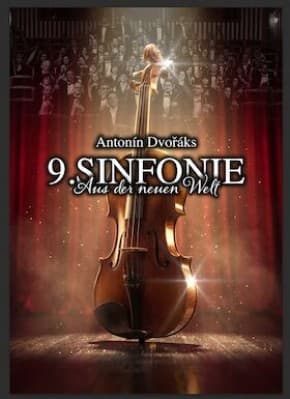
Antonín Dvořák, 9th Symphony - "From the New World" as well as P. Tchaikovsky, "Romeo and Juliet" - Overture
 Residenzstraße 1, 80333 München, Germany
- Munich, Germany

 0
0 0
0 0
0
Description
Antonín Dvořák's 9th Symphony is titled From the New World because it was inspired by Dvořák's three-year stay in America. It was known during the artist's lifetime as his 5th Symphony and is now one of his most popular and frequently performed orchestral works.
When Antonín Dvořák entered American soil in 1892 to accept the position as director of the National Conservatory of Music of America, he was already a world-famous composer. It was therefore not surprising that Jeannette Thurber, the American patron and co-founder of the New York Institute, offered him this lucrative and prestigious position.
With the 9th Symphony, created during his three-year stay in America, Dvořák produced his perhaps most popular symphonic work. Although he took on the role of conductor and teacher to train a young generation of musicians to develop a national American musical style, his 9th Symphony is by no means American music. In a newspaper interview, he explained his approach:
"I carefully studied a certain number of Native American melodies given to me by a friend, and I was completely permeated by their qualities — rather, their spirit. I tried to reproduce this spirit in my new symphony without actually using the melodies. I simply wrote original themes embodying the characteristics of Native American music, developed with the means of modern rhythms, harmony, counterpoint, and orchestral color. [...]
Well, I found that the music of the Blacks and that of the Indians was practically identical." – ANTONÍN DVOŘÁK[1]
The work reveals that Dvořák's knowledge of authentic music of Indigenous peoples and Blacks could not have been very deep. However, certain influences are still recognizable: rhythmically, especially the syncopations typical of spirituals in the main and second secondary theme of the first movement stand out. The second movement, originally conceived as a legend, processes Henry Longfellow's poetry about Hiawatha in an almost programmatic manner. The elegiac English horn melody is based on the pentatonic scale, which was quite characteristic of Indian music. However, unmistakably, the Bohemian musician with his rooted tone language in folk music also appears, e.g., in the cozy Ländler of the Scherzo trio.
The themes of the outer movements are short and concise, and the basic concept mentioned above is cyclically subordinate: the main theme of the 1st movement appears in all subsequent movements, and in the finale, the main themes of the 2nd and 3rd movements are also alluded to. Musical director MARTIN PESCHIK
NORTH BOHEMIAN SYMPHONY ORCHESTRA 1st Part
Bedrich Smetana MY FATHERLAND Duration
Vysehrad 16 min.
Vltava (The Moldau) 12 min. P. I. Tchaikovsky ROMEO AND JULIET
Fantasy Overture 22 min.
Highlights
- Performance of Dvořák's 9th Symphony "From the New World"
- Tchaikovsky's "Romeo and Juliet" Overture
- Venue: Munich Residence
General Information
The concert features the famous 9th Symphony by Antonín Dvořák, created during his stay in America. Additionally, the overture to "Romeo and Juliet" by P. Tchaikovsky will be performed, promising an exciting evening for classical music enthusiasts.
Location
Residenzstraße 1, 80333 München, Germany
Loading map...
How to get there

Event Calendar
December 2026

Event Media

More events in Munich

 Ticket: N/A
Tao Schirrmachers Collection. Eisbach Treasures
 12:00 am
- Jun 26, 2026 - Feb 7, 2027
- Prinzregentenstraße 1, 80538 München, Germany
 Ticket: N/A
Two Lanes - TWO LANES "A PART OF US" EUROPE TOUR 2026
- 8:00 pm
- Oct 1, 2026
- Zellstraße 4, Munich, 81667, Germany
 Ticket: N/A
OsamaSon - PSYKTURNAL TOUR
- 8:00 pm
- Oct 1, 2026
- Atelierstraße 24, Munich, 81671, Germany


Ready to Host an Event?
Create, manage, and promote your event in minutes.