

Experience Course: Bushcraft · Survival & Permaculture
 Obere Bahnhofstrasse 62, 3700 Spiez, Schweiz
- Spiez, Switzerland

 0
0 0
0 0
0
Description
Making Fire · Finding Water · Foraging · Building Shelter Nature provides everything we need to live – if we know how to read and use it. Fire, water, food, shelter: the four basic needs that humans have satisfied in the wilderness for millennia. Today, most of us have lost these skills. We turn on the tap, switch on the stove, shop at the supermarket, and sleep in heated houses. But what if all that was gone? Or simply: what if we go out for a day and want to manage only with what nature gives us? In this experience-oriented course, you will learn the most important bushcraft and survival basics: lighting a fire without a lighter, finding and purifying drinking water, identifying edible plants, building a simple shelter, and safely using natural resources. We work outdoors, with real materials, real challenges, and real successes. Permaculture and survival complement each other wonderfully: while bushcraft shows you how to cope in nature, permaculture teaches you how to use landscapes respectfully and sustainably. Both approaches share the same basic attitude: observe, understand, work with nature – not against it. At the end of the course, you will not only know how to make a fire but also why to do it respectfully and mindfully. What you will learn in this course
🔥 Fire & Warmth – the most important skill
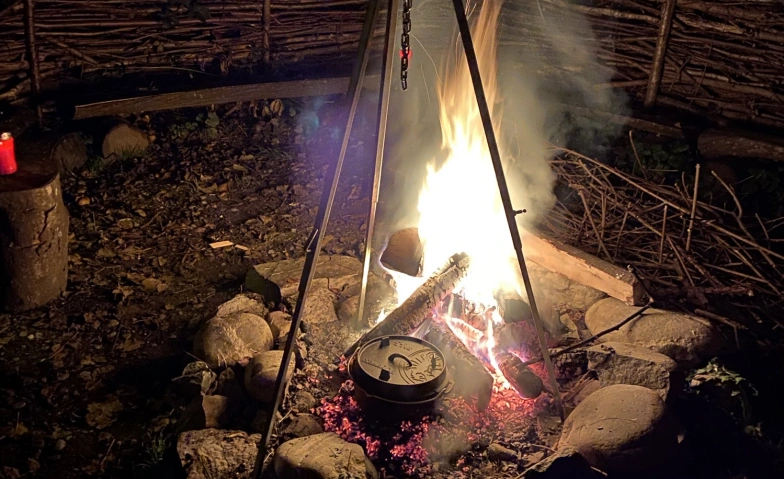
Fire is life: it warms, cooks, dries, protects, provides light, and lifts the mood. Lighting a fire without matches or a lighter is one of the most satisfying outdoor skills – and at the same time one of the most challenging. Lighting fire with natural materials: We show you various methods: fire bow, flint and steel, fire plow – and also modern aids like magnesium rods or fire lenses. You will learn which materials make good tinder (dry birch bark, cattail fluff, fine wood shavings), how to bring tinder to embers, and how to turn embers into flame. This requires patience, technique, and a bit of practice – but when it works, it is an indescribable feeling. Safe fire sites: Making a fire in nature means responsibility. We talk about fire safety: where can I make a fire? How do I prepare a safe fire site? How do I properly extinguish a fire? Ember management and cooking options: A fire does not burn forever – but embers last long. We show you how to manage embers, cook over an open fire, and generate maximum heat with minimal wood consumption. Bushcraft means not being wasteful – it means working efficiently with what is available. 💧 Finding & purifying water – vital for survival
You can survive weeks without food, but only days without water. Water is the second priority after shelter. Recognizing natural water sources: Where can you find water in nature? We talk about signs: animal tracks often lead to water. Birds fly to water sources in the morning and evening. Valleys, depressions, moist vegetation – all clues. We show you how to find springs, collect rainwater, and use dew or plant water in emergencies. Simple purification methods: Water from streams, lakes, or puddles is rarely drinkable – bacteria, parasites, viruses may lurk. We show you various purification methods: boiling, filtering, chemical treatment, and UV purification. In the course, we discuss which method fits when. Safe use in nature: Not every water source is equally good. We talk about which waters are safer (fast-flowing streams, spring water) and which are dangerous (standing water, puddles, water under willows – due to parasites). You will learn to assess water and make it safe if in doubt. 🌿 Foraging & orientation – reading nature
Food is the third priority (after shelter and water) – but in Central Europe, no one dies quickly of hunger. Still, it is valuable to know what is edible and what is not. Discovering edible wild plants: We go out together and look for edible plants: nettle, dandelion, ground elder, chickweed, beech nuts, acorns (after processing), berries (depending on the season). You learn which parts of the plant are edible (not always the whole plant), how to prepare them (some need cooking), and their nutritional value. Wild plants are often more nutritious than cultivated vegetables – if you know which to take. Recognizing dangers: Even more important than knowing what is edible is knowing what is poisonous. We discuss dangerous look-alikes, show you how to cautiously test unknown plants, and explain why the rule “When in doubt, do not eat” always applies. Basic principles of natural orientation: Without a compass or GPS – how do you find your way? We talk about natural orientation aids: moss, tree growth, sun and stars, terrain features. You learn to read nature – a skill that goes far beyond survival. 🏕️ Shelter building & outdoor techniques – staying dry and protected
Shelter is the first priority in a survival situation. Hypothermia kills faster than hunger or thirst. A simple shelter can mean the difference between life and death – or at least between a miserable and a bearable night. Simple shelter building: We build a simple emergency shelter together: a lean-to (slanted protective roof), a debris hut (insulated with leaves and branches), maybe also a tarp shelter (if we can use modern materials). You learn what matters: wind protection, ground insulation (never sleep directly on the ground – cold creeps from below), water protection (rain runs downhill, so do not build in depressions). Knots, materials, and improvisation: Bushcraft means improvising. We show you useful knots (bowline, clove hitch, reef knot – each has its function), how to make natural ropes (from nettle fibers, bark, grasses), and how to work with what is available. No hammer? Use a stone. No rope? Use roots. No tent? Build one. Staying dry and protected: Moisture is the enemy in outdoor life. We discuss layering systems (onion principle), material choice (wool stays warm even when wet, cotton does not), rain protection, and how to manage to get through the night somewhat comfortably even without modern equipment. 🌍 Connection with permaculture – use respectfully, not exploit
Bushcraft and permaculture share the same ethics: Earth Care, People Care, Fair Share. We use nature but do not harm it. We take what we need, but no more. We leave no trace. Nature observation: Before you do anything in nature, observe. Where are the trees? Where does the wind blow from? Where does the water flow? Permaculture teaches us to understand systems – and that is exactly what you need in bushcraft. Sustainable use of resources: Never take the last plant. Use dry wood, do not cut living trees. Fully extinguish your fire. Leave no trash. We talk about Leave No Trace principles – the idea that you should leave no traces in nature except maybe the imprint of your boots. Ethics in dealing with landscape and living beings: Survival does not mean exploiting nature. It means treating it respectfully. We do not kill animals for this course (that would be disproportionate and unnecessary), we do not uproot rare plants, we do not build permanent structures that damage the landscape. Bushcraft and permaculture are both philosophies of respect – and that is exactly what we teach in this course. 🎒 Materials included – you only need yourself
You do not need to bring expensive outdoor gear. Tools, natural materials, and food are provided. 🌾 How the course proceeds
We start together at the Schwarzenbach farm and then go out into nature – into the forest, onto the meadow, wherever we have space to try things out. The course is deliberately practice-oriented: we do not just talk about bushcraft, we do it. We start with fire – because without fire it gets cold and dark. You try to make fire yourself (with guidance and support) and experience how satisfying it is when the first flame rises. Then we look for water, prepare it, discuss foraging (and maybe try some edible wild plants). We build a simple shelter, practice knots, talk about orientation – and in between, there is always time for questions, stories, and some aha moments. The course is suitable for everyone: absolute beginners who have never spent a night outdoors, as well as people with some outdoor experience who want to expand their skills. Time: 1:00 PM – 5:00 PM (approx. 4-hour outdoor course) Included:
✓ All necessary tools and natural materials
✓ Small refreshments (something to eat and drink – matching the theme)
✓ Instruction by experienced course leaders
✓ Practical handout with bushcraft basics, plant lists, and knot instructions
✓ Time for questions, trying out, and exchange Bring: weatherproof clothing (October can be wet and cool), sturdy shoes or hiking boots, warm layers (we are outside, possibly in wind and weather), water bottle, curiosity, and willingness to try things that might not work immediately – because bushcraft requires patience. 👉 Registration
Are you in? Then register with us via the contact form or by email at mail@permazwerg.ch.
Highlights
- Learn bushcraft and survival techniques
- Practical exercises in nature
- Focus on permaculture and sustainable use
General Information
The experience course offers a comprehensive introduction to bushcraft and survival. Participants learn how to make fire, find drinking water, and identify edible plants while actively experiencing nature.
Location
Obere Bahnhofstrasse 62, 3700 Spiez, Schweiz
Loading map...
How to get there

Event Calendar
November 2026

Event Media


More events in Spiez
 Ticket: CHF 7
Öffentliche Führung
 10:00 am
- Oct 3 - Nov 7, 2026
- Artilleriewerk Faulensee, Kirschgartenstrasse 23a, 3705 Spiez, Switzerland
 Ticket: N/A
Sauer macht glücklich – Winterfermente
- 10:00 am
- Oct 17, 2026
- Hof Schwarzenbach, Schwarzenbach 1589, 3700 Spiez, Switzerland
 Ticket: N/A
Alex Fiva talks about his world in Skicross
- 8:00 pm
- Oct 28, 2026
- Sonnenfelsstrasse 1 , 3700 Spiez, Switzerland


Ready to Host an Event?
Create, manage, and promote your event in minutes.